The Most Fundamental Challenge Faced by Individuals with Disabilities: Accessibility
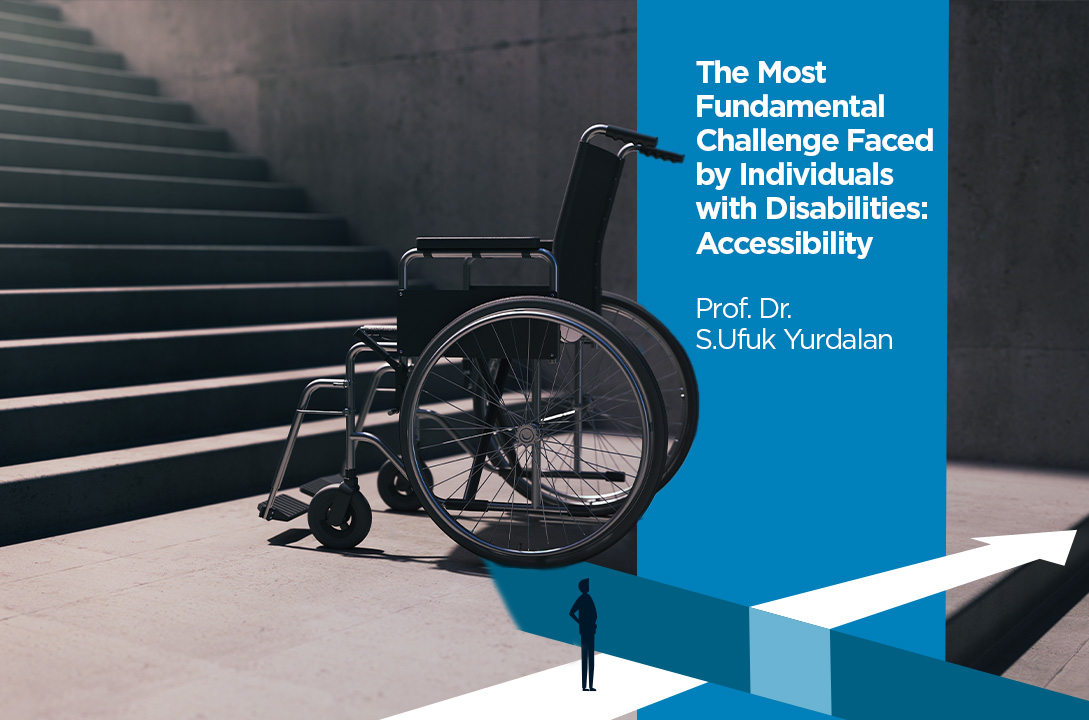
Within the scope of 3 December – International Day of Persons with Disabilities, Prof. Dr. S. Ufuk Yurdalan, a faculty member at Istinye University, evaluated the fundamental challenges faced by individuals with disabilities and proposed potential solutions. Prof. Dr. Yurdalan emphasized that accessibility remains the most critical issue for persons with disabilities. Noting that approximately 4.5 million individuals with disabilities live in Türkiye, he also highlighted the importance of social security premium incentives provided to employers who hire persons with disabilities, stating that “a corporate culture that offers opportunities to employees with disabilities is a clear indicator of an organization’s sense of social responsibility.”
Prof. Dr. Yurdalan, Head of the Department of Physiotherapy and Rehabilitation at the Faculty of Health Sciences, Istinye University, addressed the major challenges encountered by individuals with disabilities in Türkiye. According to data from the Turkish Statistical Institute (TÜİK), 6.9% of the population has at least one disability, while the National Disability Data System reports approximately 4.5 million registered individuals with disabilities. Considering Türkiye’s population of 87,774,194, millions of people face daily barriers related to accessibility, education, employment, and social participation.
“Accessibility Remains the Greatest Barrier”
Prof. Dr. Yurdalan underlined that accessibility constitutes the most significant challenge for individuals with disabilities:
“In terms of physical accessibility, infrastructure deficiencies such as inadequate ramps, elevators, pedestrian pathways, accessible restrooms, and designated parking spaces remain prevalent. In digital accessibility, many websites, mobile applications, and digital service platforms are not designed to accommodate individuals with disabilities. Access to education and employment opportunities is also limited. Individuals with disabilities are often prevented from securing employment due to discrimination and prejudice, despite the fact that access to these areas is a fundamental right and a matter of human dignity.”
Specific Challenges Faced by Individuals with Visual and Hearing Impairments
Prof. Dr. Yurdalan noted that individuals with visual impairments encounter additional barriers, particularly in education, employment, and social participation. He emphasized that technological solutions such as screen readers, artificial intelligence applications, and audio navigation systems significantly enhance independence. He also pointed out that the continued requirement for a “witness” in certain banking services for visually impaired individuals could be eliminated through appropriate regulatory and technological reforms.
Regarding individuals with hearing impairments, Prof. Dr. Yurdalan identified communication barriers as the most significant challenge:
“The lack of appropriate instructional materials and support services creates inequality in education. Similarly, employers’ concerns regarding hearing-impaired employees may negatively affect their employability.”
He further noted that communication difficulties may discourage individuals with hearing impairments from participating in social activities, leading to social isolation.
“Social Projects Are Essential for Empowerment”
Emphasizing the need for comprehensive social initiatives to empower individuals with disabilities, Prof. Dr. Yurdalan proposed several measures:
“Vocational training workshops that provide job-related skills such as computer literacy, handicrafts, and technical competencies should be established. Employment support services including CV preparation, interview training, and entrepreneurship counseling should be offered. Social participation should be enhanced through arts, cultural, and volunteer-based projects. Additionally, community service initiatives aimed at facilitating access to healthcare, education, and social services should be developed as strategic priorities.”
Critical Urban Challenges: Transportation and Infrastructure
Prof. Dr. Yurdalan outlined key steps required to make cities more disability-friendly:
“Pedestrian walkways, ramps, elevators, and public transportation stops must be redesigned. Priority access and safe travel solutions for individuals with disabilities should be implemented in public transportation systems. Public institutions should offer fast-track appointments and dedicated service hours. Disability-friendly technologies must be mandatory in new designs. Traffic lights and pedestrian crossings in central areas should be adapted for accessible use. Continuous needs assessments should be conducted, and scientific projects aimed at facilitating transportation and official procedures for individuals with disabilities should be supported.”
Innovative Technologies Strengthen Independent Living
Highlighting the role of technology in promoting independence, Prof. Dr. Yurdalan stated that artificial intelligence–supported applications are rapidly becoming widespread. Technologies such as Be My Eyes, Microsoft Seeing AI, Ava, Apollon Glasses, WeWALK Smart Cane, EyeSense, and Otsimo were cited as examples. He emphasized:
“Technology has become a powerful tool for equality, enabling individuals with disabilities to make their voices heard and enhancing their functional independence.”
He further noted that collaborative projects between the public and private sectors represent an effective strategy for advancing innovation in this field.
“Legal Incentives Exist, but Human Responsibility Is Greater”
Addressing employment incentives, Prof. Dr. Yurdalan stressed the importance of social security premium support for employers who hire individuals with disabilities and offered additional recommendations:
“Providing employment opportunities for individuals with disabilities reflects a company’s commitment to social responsibility. Work environments should be adapted to meet employees’ specific needs. Flexible and productivity-oriented work models, including task-based employment, should be expanded. Individuals with disabilities should be employed in positions aligned with their competencies. Best practices should be disseminated through national and international funding mechanisms. Educational support should also be provided for employees with disabilities who have children.”
“An Accessible Türkiye Is Possible”
Concluding his remarks, Prof. Dr. S. Ufuk Yurdalan emphasized that 3 December should extend beyond symbolic awareness:
“Removing barriers in all areas of social life requires a comprehensive policy approach and collective determination. When physical, digital, and social barriers are addressed together, 3 December can truly become a day symbolizing equality, freedom, and participation for all individuals in an accessible Türkiye.”
As an example of best practice, Prof. Dr. Yurdalan highlighted the TÜBİTAK 4008 Project on Inclusive Community Practices for Individuals with Special Needs, conducted under the coordination of Dr. Mirsad Alkan, a faculty member in the Department of Physiotherapy and Rehabilitation at Istinye University. Within the scope of this project, the event titled “Paralympic Athlete Festival: Learn, Raise Awareness, Discover Your Talent, Play with Athletes” was held on 23 October 2025 at Vadi Campus with broad participation. TÜBİTAK has decided to support the continuation of the project.