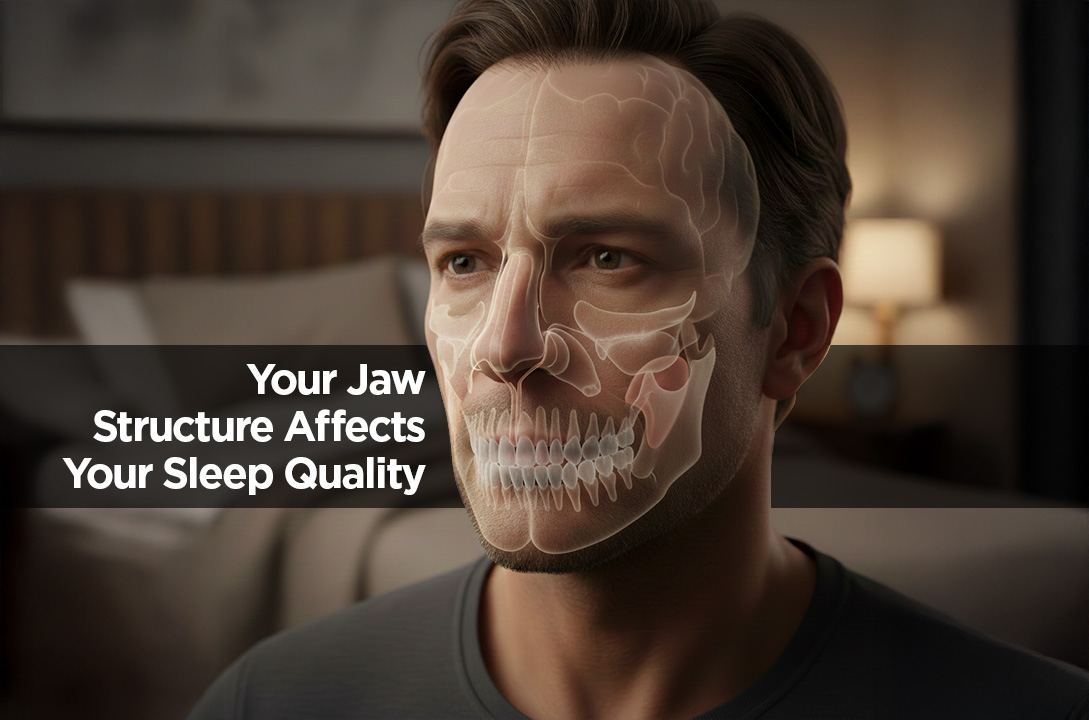
Snoring is often perceived as a trivial habit, and waking up fatigued in the morning is commonly attributed to the demands of a busy lifestyle. However, respiratory disturbances occurring during sleep have a far deeper anatomical basis that cannot be explained solely by lifestyle factors or temporary conditions. Jaw structure, as one of the primary determinants of upper airway patency, plays a silent yet decisive role in the development of snoring and obstructive sleep apnea.
The position of the maxilla and mandible, tongue posture, and intraoral volume directly influence the maintenance of airway patency, particularly during sleep. In individuals with retrusive or narrow jaw structures, the tongue and surrounding soft tissues may shift posteriorly during sleep, leading to narrowing of the upper airway. While this narrowing may initially manifest as snoring, it can progressively evolve into obstructive sleep apnea. Obstructive sleep apnea is characterized by repeated episodes of partial or complete cessation of breathing during sleep and adversely affects not only sleep quality but also daytime alertness, cognitive performance, and long-term cardiovascular health.
At this stage, accurate evaluation of jaw morphology becomes critically important. However, conventional two-dimensional diagnostic methods are often insufficient to comprehensively demonstrate the complex relationship between the jaw structures and the airway. With the advent of three-dimensional imaging technologies, digital facial scanning, and artificial intelligence–assisted analysis systems, jaw bones, dentition, soft tissues, and airway volume can now be assessed simultaneously in a comprehensive manner. Artificial intelligence enables rapid and objective analysis of these datasets, identifying airway constriction sites, high-risk anatomical structures, and potential functional impairments within seconds.
The digital assessment process extends beyond the mere identification of the existing anatomical condition. Through artificial intelligence–supported three-dimensional simulations, the potential effects of planned modifications in jaw position on airway dimensions can be predicted prior to treatment. Even minor changes in jaw positioning can be quantitatively evaluated in terms of their impact on respiratory capacity, allowing for more individualized and predictable treatment planning in patients with snoring and sleep apnea.
Respiratory problems related to jaw structure are often long-standing yet unrecognized conditions. Chronic mouth breathing, persistent snoring, or habitual morning fatigue may gradually be perceived as normal aspects of daily life. Nevertheless, these symptoms may indicate congenital or long-term structural disharmony between the jaw anatomy and the upper airway.
In conclusion, jaw structure is not merely a determinant of facial aesthetics but a functional component central to serious respiratory disorders such as snoring and obstructive sleep apnea. Advances in artificial intelligence and three-dimensional digital technologies have rendered this relationship clearer, measurable, and predictable. This holistic perspective underscores the necessity of reevaluating the role of jaw structure beyond aesthetic considerations, emphasizing its importance for healthy respiration and overall quality of life.